
$0 Fixes
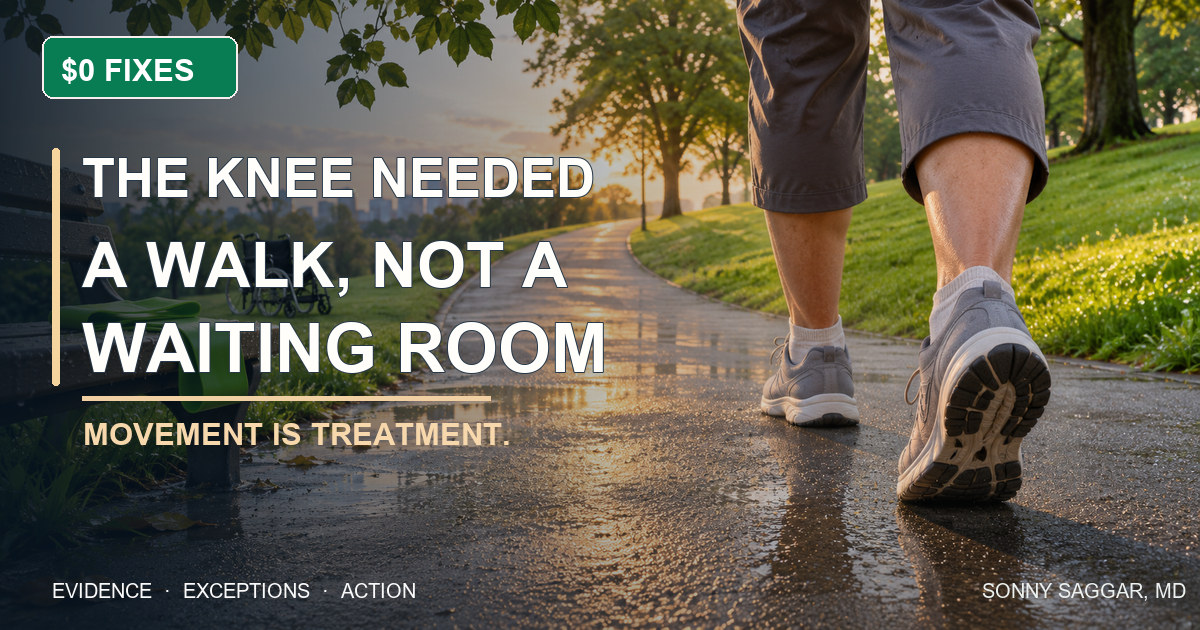
The Knee That Needed a Walk, Not a Waiting Room
For many adults living with knee osteoarthritis, regular movement and strengthening are treatments in their own right, and the first step need not cost anything.
Sonny Saggar, MD · 2026-11-20
Research commentary, not medical advice. Discuss personal health decisions with a qualified clinician or pharmacist.
The Claim
An aching knee begins to dictate the schedule. Walking hurts, so the chair wins. Weeks of avoiding movement can make stairs feel even more intimidating. For people with established knee osteoarthritis, avoiding all activity is usually not the answer. Therapeutic exercise is a core treatment that can reduce pain and improve function, according to major clinical guidelines [1,2]. It does not reverse cartilage loss or guarantee a pain-free knee. Its value is practical: better strength, mobility, confidence and the ability to keep doing daily things.
Why Rest Sounds So Persuasive
Pain is a convincing alarm. It is reasonable to protect a knee during an acute injury or an unusually severe flare. But osteoarthritis is not simply a joint wearing out every time it moves. Muscle weakness, reduced fitness, stiffness and uncertainty about safe activity all contribute to disability. A knee that has lost strength because activity has gradually disappeared may complain about the very movement that could help it recover. NICE explains that some discomfort can occur when starting exercise, while regular activity can improve pain and function over time [1]. This is permission for gradual movement, not permission to ignore alarming symptoms.
What The Evidence Shows
The American College of Rheumatology and Arthritis Foundation strongly recommend exercise for knee osteoarthritis, including options such as walking, strengthening and aquatic exercise, without declaring a single exercise superior for everyone [2]. A Cochrane systematic review of 54 trials found that land-based exercise improved pain and function in the short term, although the size and persistence of benefit varied [3]. A broader evidence review also found benefits from achievable physical activity, even below ideal public-health targets [4]. Studies differ in the participants, exercise dose and supervision provided. This is a strong case for doing something sustainable, not a magic claim about precisely ten minutes or a particular number of steps.
The First Week Is Not A Fitness Test
Start with what the knee will comfortably tolerate: perhaps a five-minute walk on level ground, gentle sit-to-stands using a stable chair or a few supported knee bends. This is an example, not a prescription for everyone. Choose a route where it is easy to turn back, and use support if balance is uncertain. Increase gradually rather than doubling the amount after a good day. The CDC advises people with arthritis to start slowly, choose joint-friendly activities and recognize that even five- or ten-minute sessions can help [5]. A physiotherapist can tailor the plan when pain, frailty, instability or other medical conditions complicate it.
The Exceptions
Do not label every painful knee as osteoarthritis. A newly hot, red, very swollen joint, fever, an inability to bear weight, a major fall or injury, sudden locking or marked new weakness needs medical assessment. Suspected joint infection is urgent. New calf swelling with pain or breathlessness may signal a different urgent problem. A severe flare may call for temporary activity adjustment and clinical guidance, not forced marching. Also seek advice before starting exercise if you have unstable heart or lung disease, recurrent falls or symptoms that substantially worsen with activity. The diagnosis and the individual risk always come before the exercise slogan.
What To Do For $0
Choose one low-impact activity you can repeat safely, such as walking indoors, supported chair rises or gentle range-of-motion movements. Pair it with a simple strengthening routine on several days each week if suitable. Keep a brief record of what you could do and how your knee felt the following day. Gradually add duration or repetitions as tolerance improves. The CDC identifies walking, cycling, gardening and water-based activity as joint-friendly options and recommends muscle-strengthening alongside aerobic movement [5]. Free activities may be enough to begin, but tailored professional instruction can make exercise safer and more effective for some people [2].
How To Tell Whether It Is Working
Judge progress by functions that matter: getting out of a chair, climbing a familiar set of stairs, walking to the shop or sleeping without being awakened by pain. Improvement is usually gradual and uneven. A little startup discomfort is not necessarily treatment failure, but marked or persistent worsening should prompt a reassessment. The evidence supports continued exercise, not an all-or-nothing challenge [1,3]. If a plan is inaccessible, painful or boring, adapt it rather than abandoning movement entirely.
What We Still Do Not Know
There is no single proven best exercise type, intensity or schedule for every knee [2]. Trial averages do not predict one individual's response, and some people need medication, support devices, physiotherapy or surgery as well as exercise. A free plan is a starting point, not a reason to withhold appropriate care. The useful question is whether the person can safely repeat the activity long enough for strength and function to improve.
Sources and receipts
- NICE, Osteoarthritis in Over 16s: Diagnosis and Management, NG226, 2022 — Source cited in the reviewed article
- American College of Rheumatology and Arthritis Foundation, Guideline for the Management of Osteoarthritis of the Hand, Hip, and Knee, 2019 — Source cited in the reviewed article
- Fransen M and colleagues, Exercise for Osteoarthritis of the Knee: A Cochrane Systematic Review, 2015 — Source cited in the reviewed article
- Kraus VB and colleagues, Effects of Physical Activity in Knee and Hip Osteoarthritis: A Systematic Umbrella Review, 2019 — Source cited in the reviewed article
- Centers for Disease Control and Prevention, About Physical Activity and Arthritis, 2024 — Source cited in the reviewed article
- American Academy of Family Physicians, Osteoarthritis Management: Updated Guidelines from the ACR and Arthritis Foundation, 2021 — Source cited in the reviewed article
From the same professional problem-solving perspective: YouTube · Spotify · Substack.