
$0 Fixes
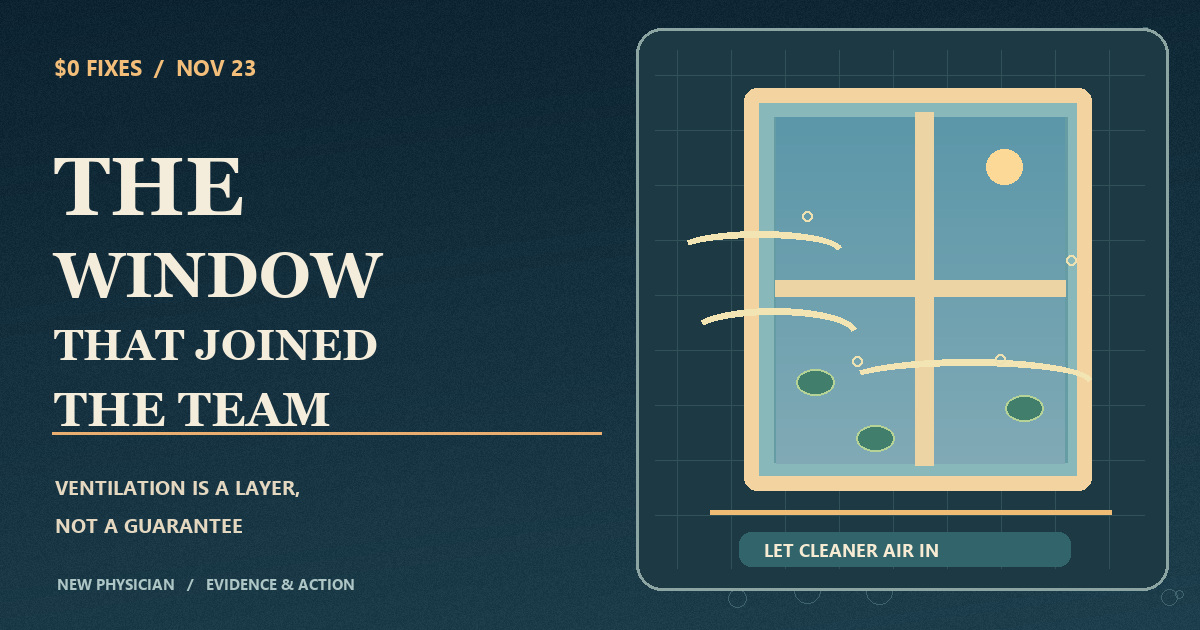
The Window That Quietly Joined the Infection-Control Team
Fresh air is not a miracle cure, but a safe opening to the outdoors can make an ordinary room less hospitable to accumulated respiratory aerosols. And it does not need a subscription.
Sonny Saggar, MD · 2026-11-23
Research commentary, not medical advice. Discuss personal health decisions with a qualified clinician or pharmacist.
The Claim
We have become extraordinarily sophisticated at shopping for healthier air and remarkably casual about asking where a room's air actually goes. Respiratory viruses can spread through the air, particularly in crowded or poorly ventilated indoor spaces. The CDC recommends cleaner air as a core prevention strategy. Safely opening a window or door is one way to bring outdoor air into a home without purchasing a device [1,2].
What An Open Window Does
People breathe out particles. In a closed room, those particles can accumulate, depending on occupancy, duration, ventilation and other factors. Bringing in outdoor air dilutes some of that indoor air, helping reduce the concentration of potentially infectious particles. It does not sterilize the room or erase risk at close range. It simply changes the air that everyone has been sharing [1,2,3].
The Two Sides Of The Room
If conditions permit, open windows or doors on opposite sides to encourage cross-ventilation. An existing exhaust fan that vents outdoors can help remove indoor air. A securely positioned fan may help move air outward, but do not direct potentially contaminated air from one person's face toward another. Fans that merely recirculate room air cannot replace outdoor air. The shape of the room and prevailing airflow matter more than the drama of a spinning blade [2,3,4].
Why Five Minutes Is Not A Prescription
The World Health Organization describes opening windows for a few minutes at intervals when outdoor temperatures are extreme. That is a practical option, not a scientifically established five-minute dose that guarantees protection. The amount of fresh air a room receives varies greatly with the window opening, wind, temperature and layout. No fixed window-opening ritual can promise a specific percentage reduction in infection risk for every home [3,4].
The Exceptions
Do not open a window where it creates a fall or security hazard. Do not invite hazardous smoke, high outdoor pollution, severe heat, cold, humidity or an asthma trigger into the room. Use judgment in buildings with controlled ventilation, vulnerable occupants or safety requirements. Where opening windows is unwise, correctly maintained mechanical ventilation and filtration may offer safer options, although those are not always free [2,5,6].
What To Do For $0
When the outdoor air and weather are suitable, open a safe window or door before visitors arrive and during an indoor gathering. If possible, create a path for fresh air to enter and stale air to leave, and use an existing exhaust fan that actually vents outdoors. Reduce crowding, shorten indoor exposure when sensible, and choose an outdoor visit when practical. This is an added layer of prevention, not a substitute for staying home when acutely ill or for other recommended precautions [1,2,3].
What Cleaner Air Cannot Do
Ventilation alone cannot tell you whether someone is contagious. It cannot guarantee that a person sitting inches from you will avoid breathing an infectious plume. Vaccination where recommended, appropriate masks in higher-risk settings, testing when useful, and care for illness remain separate decisions. A window is a tool, not a permission slip to ignore symptoms or medical advice [1,4,7].
When Health Needs More Than A Window
An older person, a pregnant person or someone with a compromised immune system may need a more protective approach around respiratory illness. Seek medical guidance for severe or worsening symptoms. Call emergency services for severe breathing difficulty, persistent chest pain, new confusion or inability to stay awake. Opening a window is not treatment for respiratory distress [1,7].
Sources and receipts
- Centers for Disease Control and Prevention, Taking Steps for Cleaner Air for Respiratory Virus Prevention, August 2025 — Source cited in the reviewed article
- Environmental Protection Agency, Ventilation and Respiratory Viruses — Source cited in the reviewed article
- World Health Organization, Coronavirus Disease: Ventilation and Air Conditioning, questions and answers — Source cited in the reviewed article
- Centers for Disease Control and Prevention, Ventilation FAQs Frequently Asked Questions, October 28 2026 — Source cited in the reviewed article
- Environmental Protection Agency, Biological Contaminants and Indoor Air Quality, 2026 — Source cited in the reviewed article
- Centers for Disease Control and Prevention, Ventilation in Schools and Childcare Programs — Source cited in the reviewed article
- Centers for Disease Control and Prevention, Preventing Spread of Respiratory Viruses When You Are Sick — Source cited in the reviewed article
From the same professional problem-solving perspective: YouTube · Spotify · Substack.