
$0 Fixes
The Burn First-Aid Kit Was Already in the Tap
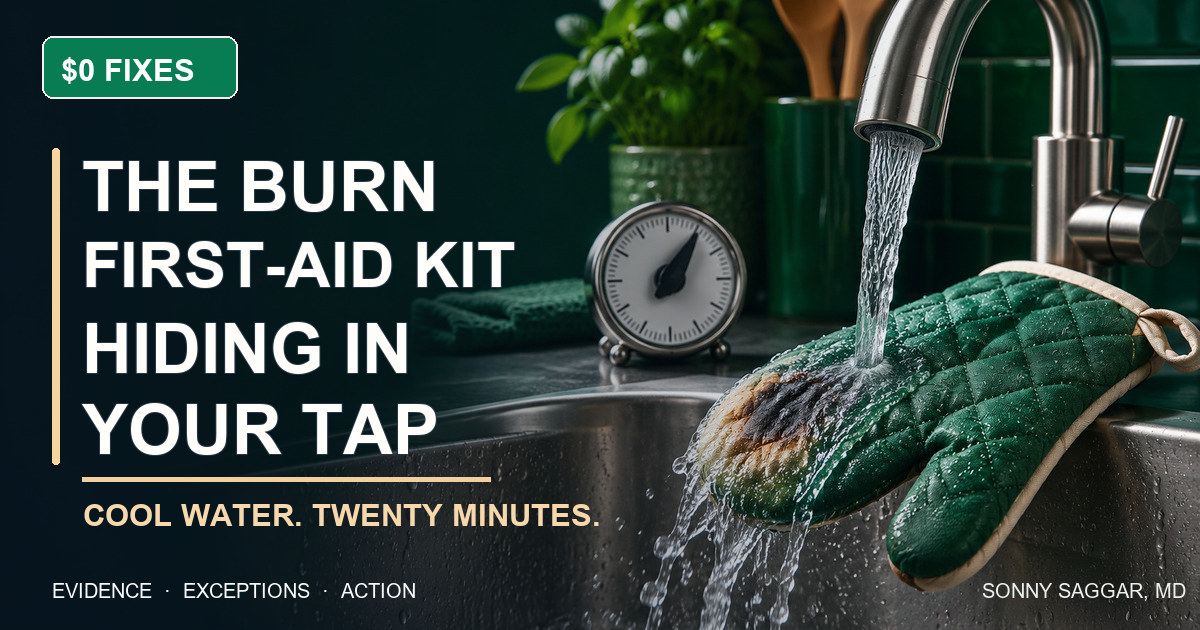
For a small thermal burn, prompt cool running water is not folklore: it is the best-supported first move, while ice and kitchen condiments can make a bad minute worse.
Sonny Saggar, MD · 2026-11-19
Research commentary, not medical advice. Discuss personal health decisions with a qualified clinician or pharmacist.
The Claim
For a recent small thermal burn or scald, stop the heat exposure and place the affected area under cool running water promptly. Twenty minutes is the commonly studied target, and starting within three hours may still help [1,2]. This is first aid, not permission to manage every burn at home. Large, deep, chemical, electrical, inhalational or high-risk-location burns require urgent professional assessment. The wonderfully inexpensive part is that the useful first step usually emerges from a tap rather than a branded tube.
The Human Data
Randomizing people to inadequate burn first aid would be ethically awkward, so the strongest human evidence is observational. In a prospective cohort of 4,918 patients with burns involving less than 10% of total body surface area, 2,859 received twenty minutes of cool running water within three hours [1]. Adequate cooling was associated with less burn depth and, among people who did not require grafting, healing about 1.9 days faster. It was not associated with a lower overall need for grafting. A later systematic review and meta-analysis found that twenty minutes of cool running water within three hours was associated with improved outcomes, while also stressing the limitations and heterogeneity of the underlying evidence [2]. Association is not randomization, and first-aid quality may travel with other advantages. The signal is nevertheless consistent enough to guide a low-risk immediate action.
Why Twenty Minutes
Twenty minutes is a practical evidence-based rule, not a sacred biological switch. A 2021 systematic review found limited direct evidence for the ideal duration [3]. Guidance therefore varies: the American Burn Association advises at least five minutes for minor burns [6], the American Red Cross recommends a minimum of ten and ideally twenty [5], and NHS guidance uses twenty minutes [7]. That disagreement is a reason to avoid false precision, not to do nothing. Start promptly, use cool—not icy—running water, keep the rest of the person warm, and do not prolong cooling past the point of shivering or hypothermia risk.
What The Water Is Doing
Cooling stops continued thermal injury, reduces tissue temperature and can relieve pain. It does not sterilize a deep wound, reverse destroyed tissue or rule out inhalation injury. Water temperature matters: ice and near-freezing treatment can reduce blood flow and deepen injury rather than rescuing it. The World Health Organization and major first-aid organizations explicitly advise against ice [4,5,6]. If clothing or jewellery is not stuck, remove it early before swelling develops. Do not pull away material adhered to the skin.
The Kitchen-Cupboard Competition
Butter, oil, toothpaste and other greasy or abrasive household remedies are not burn care [4,5]. They can retain heat, contaminate the wound and complicate assessment. After adequate cooling, a small superficial burn may be covered loosely with a clean non-adherent dressing according to local guidance. Do not burst blisters. Pain relief may be appropriate if safe for the individual, but it is an addition to cooling rather than a substitute for it. The kitchen has already contributed one useful device—the tap. It need not audition the mayonnaise.
The Exceptions
Call emergency services for breathing difficulty, facial burns with smoke exposure, altered consciousness, a major fire or explosion, or any concern for inhalation injury. Seek urgent assessment for electrical burns, significant chemical burns, burns that are large or deep, circumferential burns, or burns involving the face, hands, feet, genitals or major joints [4,5,6,7]. Children, older adults and frail people can become hypothermic during cooling; cool the burn while keeping the rest of the body warm. Chemical exposures require substance-specific safety steps, including protecting the rescuer and brushing away dry chemicals when appropriate before irrigation. Electrical injuries can be serious beneath a small skin mark. If in doubt, cool safely and get help rather than using the apparent surface size as a verdict.
What To Do For $0
Stop the burning process and move away from the heat source. Remove rings, watches and loose clothing near the burn unless stuck. Hold the affected area under cool running water, aiming for twenty minutes when safe; if treatment was delayed, starting within three hours may still be worthwhile [2,5,7]. Keep the person warm, avoid ice and home pastes, and cover the cooled burn loosely with a clean non-stick material while arranging care when indicated. Check tetanus status and wound follow-up with a clinician when appropriate. The sequence is gloriously dull: cool, protect, escalate when the burn is not minor.
What Would Change My Mind
A large randomized or carefully controlled prospective study showing that a shorter, safer cooling protocol produces equal or better healing across meaningful burn categories would refine the twenty-minute target. Evidence of hypothermia or tissue harm from the recommended protocol in a defined group would narrow it. A viral video involving butter would not.
Sources and receipts
- Griffin BR, et al. First Aid Improves Clinical Outcomes in Burn Injuries: Cohort Study of 4,918 Patients, Burns 2020 — Source cited in the reviewed article
- Harish V, et al. Twenty Minutes of Cool Running Water Within Three Hours: Systematic Review and Meta-analysis, Burns 2022 — Source cited in the reviewed article
- Cuttle L, et al. Duration of Cooling With Water for Thermal Burns: Systematic Review, Burns 2022 — Source cited in the reviewed article
- World Health Organization, Burns: First Aid and What Not to Do — Source cited in the reviewed article
- American Red Cross, Focused Updates and Guidelines 2020: Burn Care and Cooling — Source cited in the reviewed article
- American Burn Association, Burn First Aid — Source cited in the reviewed article
- NHS, Burns and Scalds: Immediate First Aid — Source cited in the reviewed article
From the same professional problem-solving perspective: YouTube · Spotify · Substack.