
The Shit List
The Toothache That Was Handed an Antibiotic Instead of a Dentist
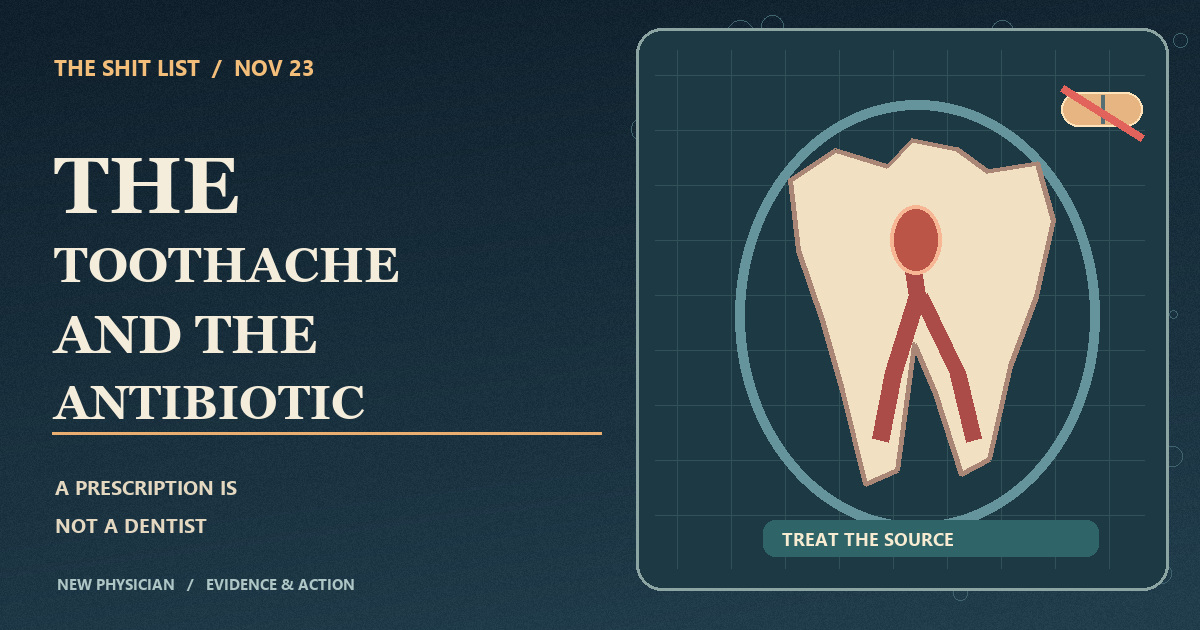
An antibiotic prescription looks decisive. For many toothaches, it is the medical equivalent of repairing the smoke alarm while the kitchen is still on fire.
Sonny Saggar, MD · 2026-11-23
Research commentary, not medical advice. Discuss personal health decisions with a qualified clinician or pharmacist.
The Claim
A person arrives with a throbbing tooth and leaves with a prescription. Everyone has done something. The tooth, unfortunately, has not received the memo. Antibiotics are sometimes essential in dental infections, but the American Dental Association's evidence-based guidance recommends against them for most pulpal and periapical pain in otherwise healthy adults. The first priority is treatment of the tooth or drainage of the source, not a ceremonial course of pills [1,2].
Why The Tooth Keeps Complaining
A painful tooth may have inflamed pulp, dead pulp, an infection around its root, or a different problem entirely. The correct treatment depends on an examination and sometimes dental imaging. A root canal, extraction or drainage may address the source. A systemic antibiotic cannot reliably remove a diseased pulp or substitute for necessary dental treatment. Even when a medicine temporarily reduces some bacterial activity, the tooth may remain structurally and biologically uncorrected [1,3].
The Evidence Does Not Say Never
The 2019 ADA guideline considered the evidence for antibiotics in urgent pulpal and periapical conditions and found little benefit in most scenarios, with potentially important harms. It made specific distinctions: a symptomatic inflamed pulp is not the same as a necrotic tooth with a localized abscess, and access to immediate definitive dental treatment matters. In selected abscess situations when treatment is unavailable, a dentist may use antibiotics or a delayed prescription. The decision belongs to the actual diagnosis and circumstances, not to the mere presence of pain [1,2,4].
What The Pills Can Cost
An unnecessary prescription can produce allergic reactions, diarrhea, drug interactions and other adverse events. Antibiotic exposure also contributes to resistance. The ADA's 2026 stewardship statement emphasizes the right indication, the right drug and the shortest effective course when medication is warranted. This is not an argument for suffering through pain. It is an argument for treating pain and its cause while avoiding medication that adds risk without fixing the problem [3,5].
The Exceptions
Fever, malaise, spreading facial swelling or evidence that an infection has moved beyond a localized dental problem changes the calculation. A person who is severely immunocompromised may require an individualized plan. An abscess when prompt dental treatment is inaccessible can also require a different approach. No one should stop an antibiotic already prescribed for a diagnosed infection on the strength of a general article. Ask the treating dentist or clinician to reassess if the diagnosis or plan is unclear [1,4,6].
What We Do About It
Ask three questions: What is the dental diagnosis? What treatment removes or drains the source? What finding makes an antibiotic necessary in this particular case? Arrange prompt dental care rather than using repeated prescriptions as a substitute for it. If appropriate for your medical history, discuss acetaminophen or ibuprofen for short-term pain relief while obtaining treatment, following label instructions and clinician advice [1,6,7]. A prescription is not a root canal.
When The Waiting Room Is The Wrong Room
Seek emergency evaluation immediately if swelling threatens breathing, speech or swallowing, if swelling involves the eye or neck, or if you cannot open your mouth normally. Rapidly worsening swelling, marked systemic illness or severe dehydration also warrants urgent assessment. These signs are not a reason to hold out for a routine dental appointment, and a pharmacy visit is not a substitute for emergency care [6,7].
The Fair Argument
Antibiotics remain a useful and sometimes lifesaving part of medicine. The mistake is not prescribing them when an infection genuinely requires systemic treatment. The mistake is treating the symptom called toothache as though it were, by itself, an indication for an antibiotic. Good antibiotic stewardship and decisive dental treatment can agree on the same patient [1,3,5].
Sources and receipts
- American Dental Association, Antibiotics for Dental Pain and Swelling Guideline, 2019 — Source cited in the reviewed article
- Lockhart and colleagues, Evidence-based clinical practice guideline on antibiotic use for urgent pulpal and periapical conditions, Journal of the American Dental Association, 2019 — Source cited in the reviewed article
- American Dental Association, Antibiotic Stewardship, including the 2026 clinical practice statement — Source cited in the reviewed article
- Guideline Central, American Dental Association Antibiotics for Dental Pain and Swelling Guideline Summary, updated May 2026 — Source cited in the reviewed article
- American Dental Association News, New CDC resources address antibiotic stewardship, May 2023 — Source cited in the reviewed article
- National Health Service, Dental abscess: symptoms and emergency advice — Source cited in the reviewed article
- National Health Service, Toothache: when to get dental and emergency care — Source cited in the reviewed article
From the same professional problem-solving perspective: YouTube · Spotify · Substack.