
$0 Fixes
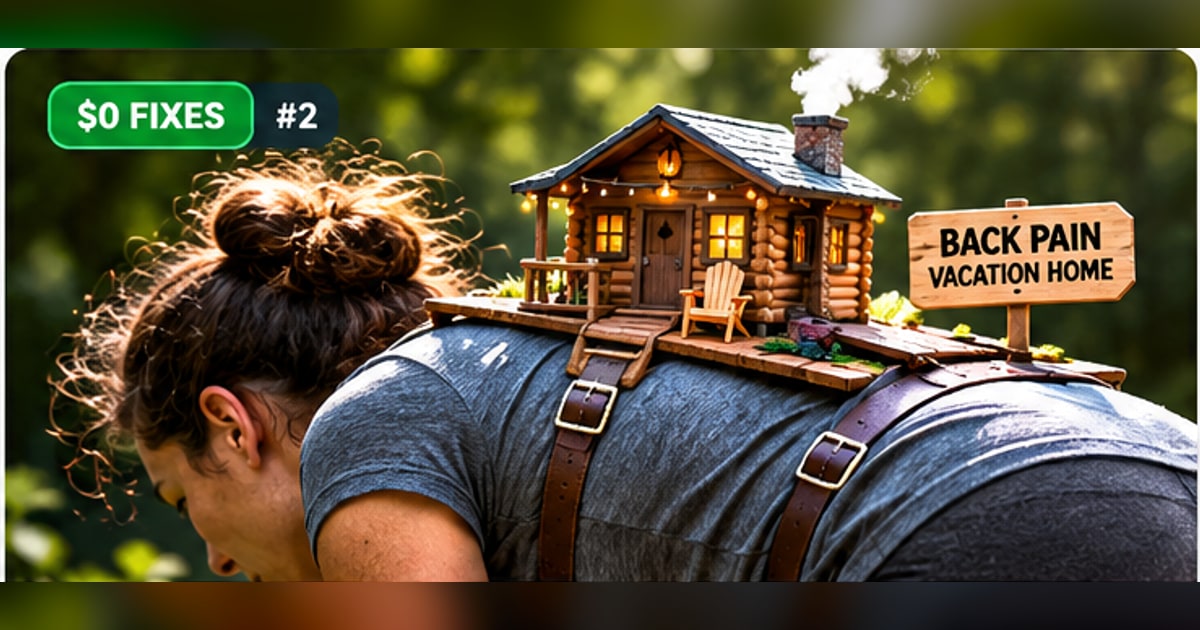
$0 Fixes #2: Your Back Does Not Need a Tiny Vacation Home
When uncomplicated low-back pain arrives, the marketplace offers a comforting plot: lie down, immobilize the problem, buy a belt, and wait for the spine to apologize.
Sonny Saggar, MD · 2026-11-05
Why it matters
The evidence tells a less decorative story. For most adults with acute nonspecific low-back pain, ordinary activity as tolerated beats bed rest. The first useful intervention may cost nothing and look suspiciously like getting on with the day.
The Claim
After serious causes have been excluded, most adults with a new episode of nonspecific low-back pain should avoid prolonged bed rest and continue normal activity as tolerated. Routine belts, corsets and traction do not earn their place at the front of the queue.
This is not “push through anything.” It is “do not turn pain into paralysis without a reason.”
The Number That Matters
In a randomized trial of 186 municipal employees with acute nonspecific low-back pain, Malmivaara and colleagues assigned 67 to two days of bed rest, 52 to back-mobilizing exercises, and 67 to continue ordinary activities as tolerated.
At three and twelve weeks, the ordinary-activity group recovered better across pain duration, pain intensity, lumbar flexion, subjective work ability, disability and days absent from work. Recovery was slowest in the bed-rest group.
The trial was small, conducted in one occupational-health system, and published in 1995. It was not blinded, and modern care has changed. But its central result has survived later evidence reviews and guidelines: for uncomplicated acute low-back pain, bed rest does not buy recovery.
Why We Still Buy Stillness
Pain is persuasive. Movement hurts, so movement feels dangerous. A brace feels like protection. Bed rest looks medical. And a product is easier to sell than a graded return to ordinary life.
The spine also attracts mechanical metaphors. If a shelf wobbles, brace it. If a hinge squeaks, stop using it. Humans are not shelving units. Avoidance can increase stiffness, deconditioning and fear of movement, while everyday activity provides repeated evidence that the back can still function.
The Best Current Synthesis
A 2025 overview of Cochrane reviews found that advice to stay active probably provides a small short-term reduction in pain compared with advice to rest in bed for acute or subacute low-back pain.
“Small” matters. This is not a miracle cure. The benefit is partly that staying active avoids the harms and lost function of unnecessary rest. It is a default strategy, not a promise that pain disappears by lunchtime.
NICE advises people with low-back pain, with or without sciatica, to continue normal activities and specifically says not to offer belts or corsets routinely. The American College of Physicians notes that most acute or subacute low-back pain improves over time regardless of treatment and recommends starting with non-drug options when treatment is needed.
For chronic primary low-back pain, WHO recommends education, exercise and selected physical or psychological therapies as parts of person-centred care, while advising against routine lumbar braces, belts or supports. Chronic pain is not merely acute pain with a longer calendar, but the anti-shopping lesson is similar: passive support is rarely the whole answer.
The Sophisticated Counterargument
Some people do benefit from short-term activity modification, medication, physical therapy, targeted exercise, manual therapy or a brace prescribed for a specific structural or postoperative indication. Severe acute pain may make ordinary activity temporarily impossible. The evidence for “stay active” is modest, heterogeneous and much stronger for nonspecific low-back pain than for sciatica, fracture, inflammatory disease or neurologic compromise.
Also, “ordinary activity as tolerated” does not mean maximal lifting, heroic exercise or ignoring escalating symptoms. One trial found a prescribed exercise program was not better than ordinary activity in the very acute phase. The $0 fix is not a boot camp. It is permission to move within tolerable limits.
What To Do For $0
If the pain is new, mechanical-seeming and no red flags are present:
- Keep getting out of bed. Brief rest for comfort is different from spending days in bed.
- Continue ordinary activities within tolerable limits. Walk, change position and perform basic daily tasks.
- Temporarily reduce movements that sharply worsen pain, then reintroduce them gradually.
- Use a simple pacing rule: do a little more than yesterday only if symptoms settle back toward baseline afterward.
- Return to work or normal roles with temporary modification when possible rather than waiting for zero pain.
- Do not buy a lumbar belt, traction device or TENS unit as the automatic first response. NICE specifically advises against routine belts, corsets, traction and TENS for low-back pain.
- If symptoms are not improving, function is deteriorating, or pain keeps recurring, seek an assessment and a tailored plan.
Safety Red Flags: This Is Not A Stay-Home List
Seek urgent medical evaluation for back pain with:
Sciatica with stable symptoms is not automatically an emergency, but progressive weakness, cauda equina features or severe functional loss changes the equation.
- New urinary retention, loss of bladder or bowel control, saddle numbness, or rapidly progressive leg weakness.
- Fever, chills, immune suppression, injection-drug use, or concern for spinal infection.
- Major trauma, known osteoporosis, prolonged steroid use, or possible fracture.
- A history of cancer, unexplained weight loss, or relentless night pain.
- Pulsatile abdominal pain, fainting, chest pain, or symptoms suggesting a vascular emergency.
- Severe pain with pregnancy complications.
- New neurologic deficit, or pain and weakness that are rapidly worsening.
Clinical Exceptions
A clinician may prescribe protection or a support for a defined fracture, postoperative recovery, inflammatory instability or another specific diagnosis. Older adults and people at high fall risk may need an individualized mobility plan. Chronic primary low-back pain may require a package of education, exercise, psychological support and selected treatment, not a single slogan.
What Would Change The Conclusion
A large, rigorous trial showing that routine bed rest or routine lumbar supports produce clinically meaningful improvements in pain, disability and return to work, without greater deconditioning or dependency, would change the recommendation. So would a reproducible subgroup with clear benefit. Current guidelines leave room for specific indications, not routine shopping.
Your back may need evaluation, time and a sensible plan. It probably does not need to be tucked into bed and served breakfast.
Sources and receipts
- Malmivaara A, et al. The Treatment of Acute Low Back Pain: Bed Rest, Exercises, or Ordinary Activity? N Engl J Med. 1995;332:351-355. DOI: 10.1056/NEJM199502093320602 — Source cited in the reviewed article
- Dahm KT, et al. Advice to rest in bed versus advice to stay active for acute low-back pain and sciatica. Cochrane Database Syst Rev. DOI: 10.1002/14651858.CD007612.pub2 — Source cited in the reviewed article
- Rizzo RRN, et al. Non-pharmacological and non-surgical treatments for low back pain in adults: an overview of Cochrane reviews. Cochrane Database Syst Rev. 2025. DOI: 10.1002/14651858.CD014691.pub2 — Source cited in the reviewed article
- Qaseem A, et al. Noninvasive Treatments for Acute, Subacute, and Chronic Low Back Pain. Ann Intern Med. 2017;166:514-530. DOI: 10.7326/M16-2367 — Source cited in the reviewed article
- NICE. Low back pain and sciatica in over 16s: assessment and management. NG59. — Source cited in the reviewed article
- World Health Organization. WHO guideline for non-surgical management of chronic primary low back pain in adults in primary and community care settings. 2023. — Source cited in the reviewed article
- Hides JA, et al. Bed rest or normal activity for patients with acute low back pain: a randomized controlled trial. Spine. DOI: 10.1097/00007632-200207150-00002 — Source cited in the reviewed article
From the same professional problem-solving perspective: YouTube · Spotify · Substack.