
$0 Fixes
Brush, Spit, and Leave the Tap Alone
One tiny change in the bathroom keeps fluoride where it can help. No new gadgets, miracle paste, or heroic personality required.
Sonny Saggar, MD · 2026-11-11
The Claim
There is a curious ritual in our bathrooms. We brush our teeth with fluoride toothpaste, then immediately wash much of the fluoride away.
It is rather like applying sunscreen and taking a shower to celebrate.
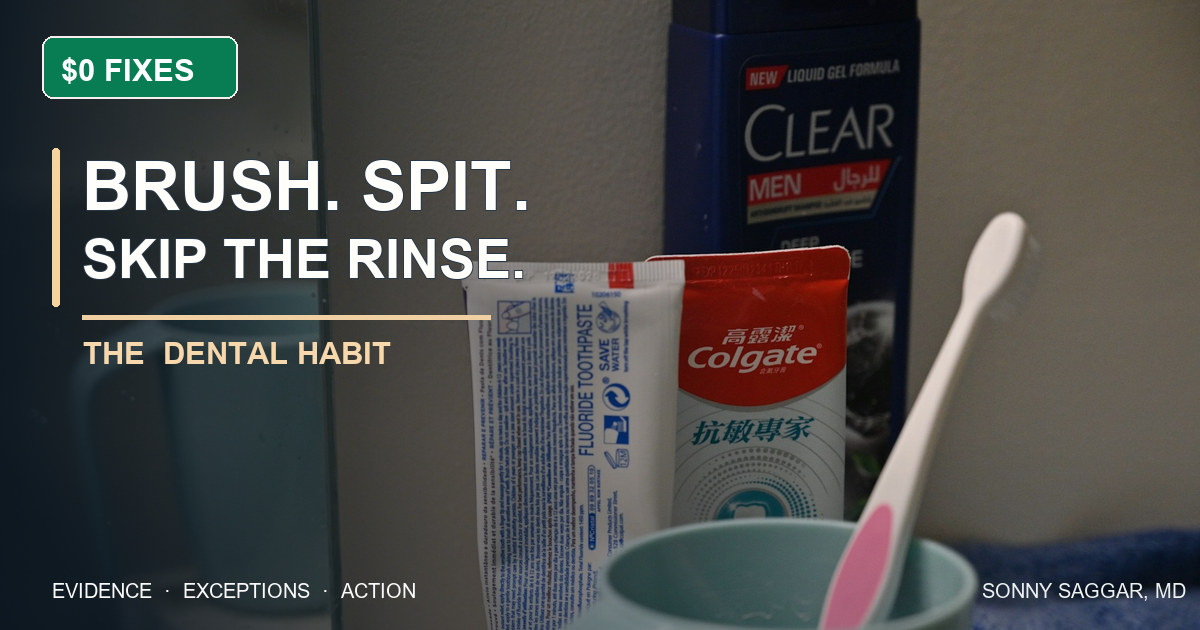
Here is the $0 Fix: spit, but do not immediately rinse with water.
Why Fluoride Matters
Fluoride helps protect tooth enamel against acid attacks. It works locally, on the surface of teeth and in saliva. The UK’s National Health Service specifically advises spitting out excess toothpaste without rinsing straight after brushing, because rinsing dilutes the concentrated fluoride left behind. [1] The US Centers for Disease Control and Prevention likewise describes fluoride remaining on teeth and in saliva. [2]
What The Study Measured
That is a biological argument. What does the research actually show?
A 2022 randomized trial assigned 120 adults across 12 groups to different toothpaste formulations, with or without a post-brushing water rinse. Researchers measured fluoride in saliva over 90 minutes, not new cavities years later. Toothpaste formulation and rinsing practices affected fluoride retention; results differed by formulation. [3]
What The Evidence Does Not Prove
So this trial supports a sensible mechanism, not the claim that skipping a rinse has been proven to cut cavities by a particular percentage. If somebody gives you that number with suspicious confidence, ask to meet the study.
The stronger clinical-outcome evidence concerns fluoride toothpaste itself. A Cochrane review of 96 studies found that several common fluoride concentrations reduce tooth decay compared with toothpaste without fluoride. That is not a direct comparison of rinse versus no rinse. [4]
What To Do For $0
The practical routine is pleasingly dull. Brush twice daily with fluoride toothpaste, cleaning all surfaces. Afterward, spit out the excess. Skip the immediate water rinse. If you like fluoride mouthwash, use it at another time rather than washing away concentrated toothpaste fluoride right after brushing. [1,5,6]
The Exceptions
For young children, the safety rules matter more than the cleverness. Adults should supervise brushing and prevent swallowing. The CDC recommends no more than a rice-grain smear under age three, and a pea-sized amount from ages three through six; for children younger than two, consult a dentist or clinician about fluoride products. [2] Do not substitute adult-strength or prescription toothpaste for a child’s prescribed regimen.
And please keep your dental appointments. A hole in a tooth is not impressed by an excellent closing routine.
The Verdict
The improvement here is modest, plausible, inexpensive, and easy. It is not a cure for cavities, nor a replacement for brushing or individualized dental care.
Sources and receipts
- [1] NHS, “How to keep your teeth clean”: — Source cited in the reviewed article
- [2] CDC, “About Fluoride”: — Source cited in the reviewed article
- [3] Albahrani MM et al. “Salivary fluoride concentration following toothbrushing with and without rinsing: a randomised controlled trial.” BMC Oral Health. 2022;22:53. PMID 35241051. — Source cited in the reviewed article
- [4] Walsh T et al. Cochrane Review CD007868, 2019, “Fluoride toothpastes of different strengths for preventing tooth decay”: — Source cited in the reviewed article
- [5] NHS Inform, “Teeth cleaning guide”: — Source cited in the reviewed article
- [6] American Dental Association, “Fluoride: Topical and Systemic Supplements”: — Source cited in the reviewed article
From the same professional problem-solving perspective: YouTube · Spotify · Substack.