
$0 Fixes
$0 Fixes #1: The Cold Medicine That Doesn’t Unblock Your Nose
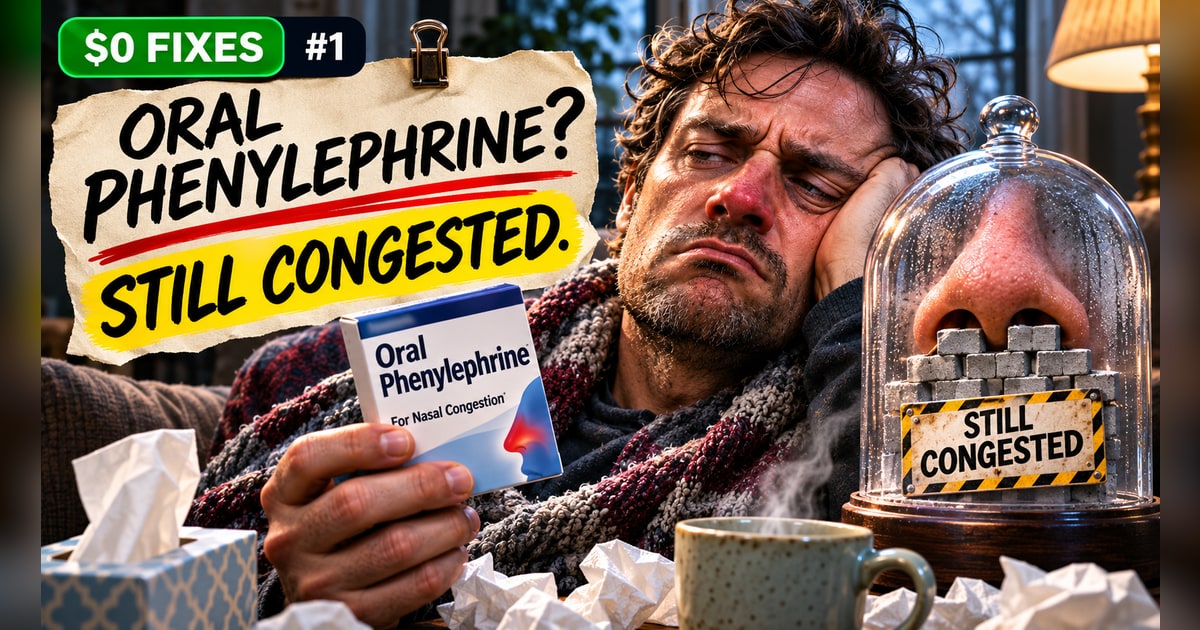
The nose is blocked. The wallet is open. The evidence has a small objection.
Sonny Saggar, MD · 2026-11-05
The verdict
What is sold: Oral phenylephrine, sometimes labelled PE, in tablets or liquid cold and allergy medicines claiming relief of nasal congestion.
What the evidence shows: A major FDA review concluded that oral phenylephrine is not effective for that purpose at the permitted doses. The agency proposed removing it from the relevant over-the-counter nasal decongestant monograph in November 2024. That proposal was not a final ban as of the FDA’s latest published consumer guidance. [1,2]
The $0 fix: Read the active ingredients and stop paying for oral phenylephrine in the expectation that it will unblock your nose. That does not mean you must suffer through every symptom, stop other medicines or abandon medical care.
It means the first treatment is occasionally not buying the treatment.
The remarkable confidence of a cardboard box
A blocked nose can reduce a perfectly sensible adult to someone prepared to purchase almost anything in a pharmacy. You cannot sleep. You cannot taste your dinner. You sound as though you are speaking from inside a wardrobe.
Then you see the box. Serious typeface. Scientific name. A reassuring diagram of somebody breathing freely, which is both attractive and, for the moment, rather aspirational.
There is nothing wrong with wanting relief. The question is whether the ingredient being sold actually supplies it.
That ingredient is often phenylephrine, taken by mouth. You may have found it in a product with other ingredients, some of which have entirely different purposes. A prestigious place on a pharmacy shelf is not, sadly, a substitute for a clinical trial.
The experiment the packaging didn’t mention
In one randomised trial, researchers allocated 539 adults with seasonal allergic rhinitis to oral phenylephrine at 10, 20, 30 or 40 mg, or placebo. Over seven days, none of the phenylephrine groups achieved a statistically significant improvement over placebo in the nasal congestion outcomes assessed. [3]
That study was open label, with subjective symptom assessments. Participants could know what they had been assigned. That creates legitimate room for bias, which is one reason the best evidence comes from more than one trial.
A separate randomised, double-blind, placebo-controlled trial tested a modified-release 30 mg oral formulation in 575 people with allergic rhinitis. The average change in congestion score was minus 0.394 with phenylephrine and minus 0.412 with placebo, with P = 0.2655. The drug did not outperform placebo on the primary outcome. [4]
That does not mean every tablet is physically incapable of causing any effect. It means the tested products did not demonstrate the advertised clinical benefit in those trials. The studies were conducted in adults with allergic rhinitis, not in every conceivable population with a blocked nose. FDA assessed a wider body of historical evidence, modern studies and pharmacology when reaching its proposed regulatory conclusion. [1,5]
The distinction matters. It is the difference between journalism and shouting at a box.
Why is it still on the shelf?
Because permission to sell a drug and convincing modern evidence of benefit are not the same thing. A 2023 FDA advisory committee concluded the scientific data did not support the efficacy of oral phenylephrine at recommended doses. Its concern was effectiveness, not a new safety signal at those doses. [5]
In November 2024 FDA proposed, but did not finalise, removing the ingredient from the relevant OTC monograph. Under FDA’s published process, products may remain on sale until a final order. [1,2]
It is not a recall, not a ban and not a verdict on every ingredient in a combined cold remedy. I wish the evidence moved through the system with the brisk efficiency of a marketing launch, but accuracy requires patience with the actual regulatory status.
The fair argument for keeping it
A manufacturer might say that phenylephrine has a plausible mechanism, that older studies supported its use, and that poor absorption when swallowed does not automatically prove a drug cannot work. Those are reasonable scientific objections to simplistic arguments about pharmacology. They were among the issues put to the FDA review. [6]
The better response is not to sneer at the mechanism. It is to ask whether adequately tested doses give people a meaningful improvement in congestion. The modern trials, including the blinded 575-person study, were not encouraging. [3,4]
And if you took a tablet and felt better? I believe you felt better. Colds fluctuate, symptoms improve naturally, placebo effects are real, and combination products may treat other symptoms. Feeling better after taking something does not, on its own, establish which ingredient caused the improvement.
The patient is not mistaken about feeling better. The inference about why may be.
What actually costs nothing?
There is no proven $0 instant cure for a blocked nose. I would be suspicious of anyone claiming otherwise, especially if there was a checkout button underneath.
The defensible saving is not buying oral phenylephrine for nasal congestion. I am not inventing a saving per customer. That would require a dated price comparison and some knowledge of what the customer would otherwise buy.
For an uncomplicated cold, CDC recommends time, rest, fluids and sensible symptom relief. Antibiotics do not treat the viruses that cause colds. A clean humidifier or saline spray, if already available, may improve comfort, although the evidence for each measure differs. [7]
If you use a nasal irrigation device, do not use untreated tap water. FDA recommends distilled, sterile or previously boiled and cooled water. [8] Those who need more relief can ask a pharmacist about appropriately selected treatments, some of which are neither free nor suitable for everyone. [2]
What we do about it
1. Turn the box over. The active ingredients matter far more than the front. Look for phenylephrine and establish whether the preparation is swallowed or sprayed into the nose. FDA’s proposal concerns oral formulations, not topical nasal phenylephrine. [2]
2. Ask what you are actually treating. A headache, cough, fever and blocked nose are different problems. Multi-ingredient medicines can cause duplicate dosing when taken alongside other products.
3. Don’t pay for an unsupported promise. Avoid buying oral phenylephrine specifically for nasal decongestion. If an existing combination medicine helps another symptom, that is a different question.
4. Give an uncomplicated cold reasonable time. Use supportive measures and avoid unnecessary antibiotics. Do not confuse waiting with ignoring a worrying symptom. [7]
5. Get proper advice when needed. FDA advises seeking professional help if congestion does not improve within seven days or is accompanied by fever. CDC also recommends evaluation for symptoms that persist beyond ten days without improvement, worsen after initial improvement, or include breathing difficulty or dehydration. People at higher risk from influenza or COVID-19 may need prompt testing and treatment. [2,7]
When $0 is the wrong answer
Trouble breathing, severe illness, dehydration, a concerning severe headache, facial swelling, persistent one-sided blockage, or symptoms in a very young child require appropriate medical assessment rather than a blog-based shopping strategy. Do not discontinue prescribed medicines based on this article.
The point is not that every medicine is a con or that everybody should treat themselves. It is that we should expect a treatment to earn its place on the shelf through evidence, and its place in our basket through usefulness.
For a surprisingly large part of the health industry, that is an alarmingly radical request.
About $0 Fixes
$0 Fixes is an evidence-and-action series by Sonny Saggar, MD, looking at the things we buy to feel better and the simpler alternatives that may be just as useful, sometimes more so. Future instalments will cover ordinary pain, sleep, first aid, prevention, avoidable tests and the persistent belief that a bigger bill means better care. Each piece separates the marketing claim from the trial, shows what can be done without buying another product, and states plainly when professional treatment is the better decision. Free does not mean miraculous. Neither does expensive. And lamentation without action is useless.
Sources and receipts
- FDA. Proposed order to remove oral phenylephrine’s OTC nasal-decongestant indication, 7 November 2024. — Original cited source [1]
- FDA. Key Information About Nonprescription Oral Phenylephrine, including current regulatory status and the distinction from nasal sprays. — Original cited source [2]
- Meltzer EO et al. Oral phenylephrine dose-ranging randomised trial, 539 adults. J Allergy Clin Immunol Pract. 2015. DOI: 10.1016/j.jaip.2015.05.007. — Original cited source [3]
- Meltzer EO et al. Modified-release phenylephrine randomised blinded trial, 575 adults. Ann Allergy Asthma Immunol. 2016. DOI: 10.1016/j.anai.2015.10.022. — Original cited source [4]
- FDA. Advisory committee clarification, 14 September 2023. — Original cited source [5]
- FDA. 2023 Nonprescription Drugs Advisory Committee materials, including industry counterarguments and pharmacology. — Original cited source [6]
- CDC. Manage Common Cold, 11 March 2026. — Original cited source [7]
- FDA. Is Rinsing Your Sinuses With Neti Pots Safe? — Original cited source [8]
From the same professional problem-solving perspective: YouTube · Spotify · Substack.