
$0 Fixes
The Bedtime Cough and the Teaspoon in the Cupboard
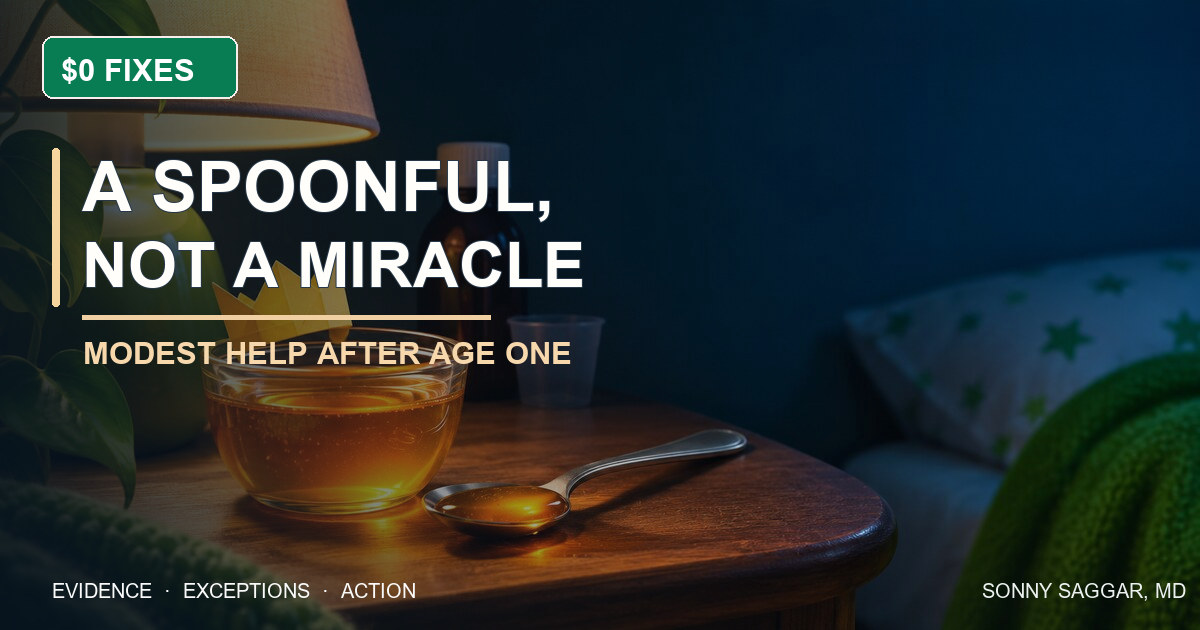
For children older than one with a short, uncomplicated viral cough, honey may modestly ease the night. It is a comfort measure, not a diagnosis and certainly not a miracle.
Sonny Saggar, MD · 2026-11-12
The Claim
A child coughs. Nobody sleeps. The medicine cabinet begins auditioning for a West End revival.
For a child older than twelve months with a short viral upper-respiratory infection and no breathing difficulty or other red flag, a small spoonful of honey before bed is a reasonable zero-dollar option. It may reduce parent-rated cough frequency and improve sleep a little. The effect is modest, the evidence is imperfect, and the age limit is absolute.
What The Numbers Say
The 2018 Cochrane review pooled small randomized trials. On a seven-point symptom scale, honey reduced cough frequency more than no treatment by a mean 1.05 points (95% confidence interval 0.62 to 1.48 points better; two studies, 154 children). Against placebo, the mean difference was 1.62 points, but that estimate also came from only two studies and 402 children. [1]
In the 2007 randomized trial of 105 evaluable children aged 2 to 18 years, parents rated buckwheat honey better than no treatment for combined cough and sleep outcomes; dextromethorphan was not significantly better than no treatment. [2] A 2012 double-blind trial enrolled 300 children aged 1 to 5 years and found greater overnight improvement with three honey products than with a silan date-extract placebo. [3]
These are one-night, parent-reported outcomes. They answer “might tonight be slightly less dreadful?” They do not show that honey cures the infection, shortens illness or prevents complications.
The Strongest Objection
A later multicentre placebo-controlled study found that both honey and syrup placebo groups improved over two nights, with no pharmacological advantage for honey. [4] That matters. Coughs fluctuate, parents expect improvement, sweet syrups soothe, and blinding honey is difficult.
The honest conclusion is narrower than the sales pitch: honey is a reasonable comfort option after age one, with uncertain specific pharmacological benefit. It competes with doing nothing or buying another bottle, not with antibiotics for bacterial disease, inhalers for asthma or urgent treatment for respiratory distress.
The Exceptions
Never give honey to a child younger than twelve months because of infant botulism risk. [5] Do not use it when swallowing is unsafe, aspiration is a concern or a clinician has advised against oral intake.
Honey is sugar. Repeated bedtime use without tooth brushing can increase dental exposure, and families managing diabetes should account for it. Allergy is uncommon but possible. “Natural” remains a description, not an indemnity policy.
What To Do For $0
For a child older than one with an uncomplicated short cough, offer a small spoonful of honey on its own or in a warm drink before bed. Keep fluids available, use saline nose drops or spray for congestion, and avoid smoke exposure.
Do not combine products casually. The US Food and Drug Administration warns that over-the-counter cough and cold medicines are not recommended for children younger than two, and manufacturers label them “do not use” in children under four. [6] More bottles do not create more respiratory wisdom.
When The Cupboard Is Not Enough
Seek urgent care for struggling or fast breathing, blue or grey lips, pauses in breathing, severe wheeze or stridor, unusual sleepiness, dehydration, drooling or inability to swallow, a suspected foreign body, or a seriously unwell child. Babies, children with significant heart or lung disease, and immunocompromised children deserve a lower threshold for assessment.
Arrange clinical review when fever is persistent or concerning, cough lasts longer than expected, symptoms worsen after initial improvement, or there is recurrent nighttime cough, exertional cough, weight loss or another reason to suspect asthma, pneumonia, pertussis or something beyond a simple viral cold. NICE advises that acute cough commonly lasts up to three or four weeks, but red flags change the plan. [7]
What Would Change The Verdict
Large, well-blinded trials using identical syrups, objective cough counts and more than one night of follow-up could show whether honey itself adds meaningful benefit. For now, the signal is plausible, modest and cheap.
The cupboard remedy wins no Nobel Prize. It may, however, buy one slightly quieter bedtime—and at 2 a.m., peer review can feel very far away.
Sources and receipts
- [1] Oduwole O et al. Honey for acute cough in children. Cochrane Database of Systematic Reviews. 2018;CD007094. DOI 10.1002/14651858.CD007094.pub5. — Source cited in the reviewed article
- [2] Paul IM et al. Effect of honey, dextromethorphan, and no treatment on nocturnal cough and sleep quality. Archives of Pediatrics and Adolescent Medicine. 2007;161:1140-1146. DOI 10.1001/archpedi.161.12.1140. — Source cited in the reviewed article
- [3] Cohen HA et al. Effect of honey on nocturnal cough and sleep quality: a double-blind, randomized, placebo-controlled study. Pediatrics. 2012;130:465-471. DOI 10.1542/peds.2011-3075. — Source cited in the reviewed article
- [4] Miceli Sopo S et al. Multicentre, randomised study found that honey had no pharmacological effect on nocturnal coughs and sleep quality at 1-5 years of age. Acta Paediatrica. 2022. — Source cited in the reviewed article
- [5] Centers for Disease Control and Prevention. Botulism Prevention: do not feed honey to a child younger than one year. — Source cited in the reviewed article
- [6] US Food and Drug Administration. Use Caution When Giving Cough and Cold Products to Kids. — Source cited in the reviewed article
- [7] National Institute for Health and Care Excellence. Cough (acute): antimicrobial prescribing, recommendations and self-care evidence. — Source cited in the reviewed article
From the same professional problem-solving perspective: YouTube · Spotify · Substack.