
The Shit List
The Shit List #2: The Oxygen Mask That Became a Reflex
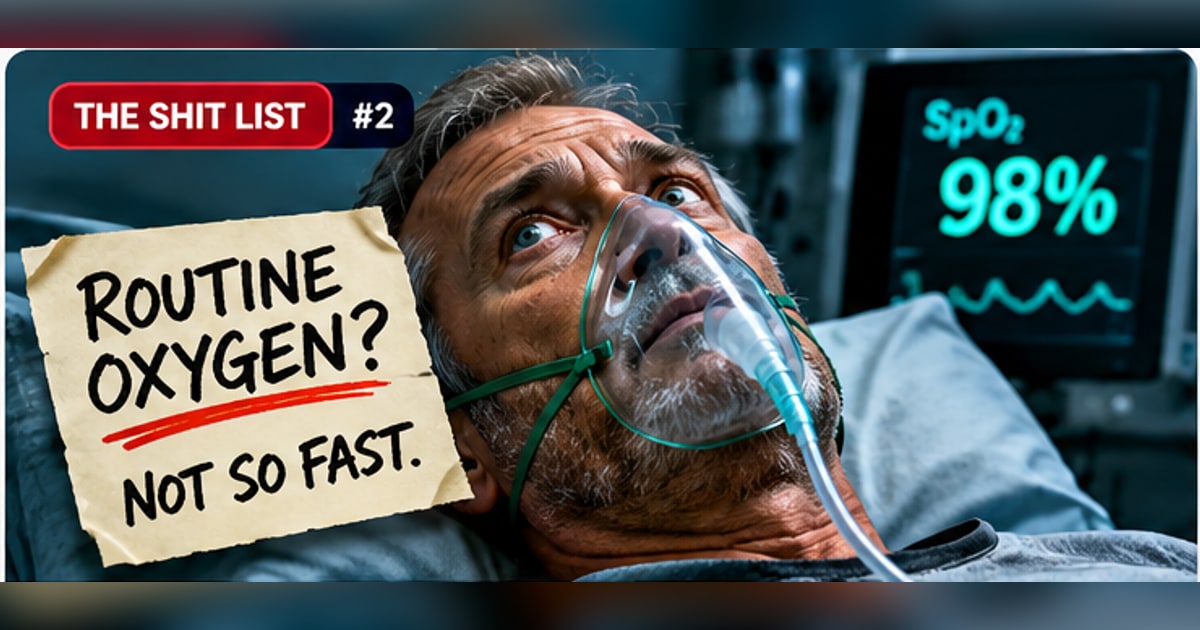
A heart attack feels like an oxygen problem. So we put oxygen on the patient. It is tidy, visible and emotionally satisfying. It is also usually the wrong reflex when the patient’s oxygen saturation is already 90% or higher.
Sonny Saggar, MD · 2026-11-05
The Claim
For adults with suspected acute coronary syndrome whose oxygen saturation is at least 90%, routine supplemental oxygen does not improve cardiovascular outcomes. Measure first. Treat hypoxemia, respiratory distress and other genuine indications. Do not treat the atmosphere in the room.
Why The Habit Persists
The story is irresistible: an artery is blocked, the heart is starved, and oxygen must help. Oxygen is also fast, familiar and culturally coded as serious care. It gives everyone something to do while the important work begins.
But oxygen delivery is not the same as oxygen need. Once arterial hemoglobin is already well saturated, pushing the number higher may add little useful oxygen content. Hyperoxia can also cause coronary vasoconstriction and oxidative stress. More oxygen is not automatically more oxygen where ischemic myocardium needs it.
The Number That Should Stop The Reflex
DETO2X-AMI randomized 6,629 patients with suspected myocardial infarction and baseline oxygen saturation of at least 90% to 6 L/min oxygen for 6 to 12 hours or ambient air.
At one year:
That is not proof that oxygen never matters. It is evidence that routine oxygen did not rescue normoxemic patients as a class.
- 166 of 3,311 patients assigned oxygen died, 5.0%.
- 168 of 3,318 assigned ambient air died, 5.1%.
- Hazard ratio 0.97, 95% confidence interval 0.79 to 1.21; P=0.80.
- Rehospitalization with myocardial infarction was 3.8% with oxygen and 3.3% with ambient air.
The Other Trials
AVOID randomized 638 patients with paramedic-diagnosed STEMI; 441 had confirmed STEMI and entered the primary analysis. Oxygen at 8 L/min did not improve the primary injury measures and raised concern about greater myocardial injury and infarct size. The study was smaller, open-label, and not powered for mortality. It is a warning signal, not a final verdict.
SOCCER used cardiac magnetic resonance imaging in normoxemic STEMI patients treated with primary PCI. It found no improvement in myocardial salvage with routine oxygen. Again, it was small and focused on surrogate imaging outcomes rather than death.
Long-term DETO2X follow-up also found no benefit: the composite of all-cause death or heart-failure hospitalization occurred in 11.2% of the oxygen group and 10.8% of the ambient-air group over a median 2.1 years, hazard ratio 1.02.
The Sophisticated Counterargument
A clinician can reasonably say that these trials do not cover every patient standing in front of us. DETO2X was open-label, pragmatic and conducted in Sweden. The sickest patients, including those with cardiac arrest or a clear oxygen requirement, were not the population being tested. Pulse oximeters can lag, fail in low perfusion and perform less accurately across skin pigmentation. A patient at 91% with pulmonary edema is not the same as a comfortable patient at 98%.
Correct. The evidence supports selective oxygen, not oxygen nihilism.
The Exceptions That Matter
Give and titrate oxygen when there is a genuine indication, including:
Clinical judgment still has a job. It simply has to arrive before the mask.
- Confirmed hypoxemia. The 2025 ACC/AHA acute coronary syndrome guideline recommends oxygen when saturation is below 90%, targeting at least 90%.
- Respiratory distress, acute pulmonary edema, shock or another condition impairing oxygen delivery.
- A falling or unreliable reading when the clinical picture suggests hypoxemia, while confirming with better monitoring or blood gas assessment when appropriate.
- Cardiac arrest and post-arrest care, which require their own oxygen strategy.
- Chronic hypercapnic respiratory failure, where indiscriminate high-flow oxygen can be harmful and the target is usually lower, often 88% to 92% pending blood gases and protocol.
What We Do About It
For EMS and emergency departments:
For patients and families:
Do not refuse oxygen during a suspected heart attack. Ask one calm question: “What is the oxygen saturation, and what are we treating?” The answer may be hypoxemia, pulmonary edema or shock. If so, the mask belongs. If the answer is “because we always do,” the evidence has already left the building.
- Put pulse oximetry next to the first ECG, not behind it.
- Write the threshold into the ACS order set: no routine oxygen at saturation 90% or higher without another indication.
- Document the indication and target range when oxygen is used.
- Reassess after every intervention. Oxygen is a drug, not wallpaper.
- Audit oxygen use in normoxemic ACS as a de-implementation metric.
What Would Change The Conclusion
A large randomized trial showing lower mortality, reinfarction or heart-failure hospitalization in a clearly defined normoxemic subgroup would change this conclusion. So would validated evidence that current pulse-oximetry thresholds systematically miss a subgroup that benefits from oxygen. Until then, the best-supported rule is simple: oxygen for hypoxia, not for theatre.
The oxygen cylinder is not a ceremonial object. It should be opened because a patient needs oxygen, not because the room needs reassurance.
Sources and receipts
- Hofmann R, et al. Oxygen Therapy in Suspected Acute Myocardial Infarction. N Engl J Med. 2017;377:1240-1249. DOI: 10.1056/NEJMoa1706222 — Source cited in the reviewed article
- Stub D, et al. Air Versus Oxygen in ST-Segment-Elevation Myocardial Infarction. Circulation. 2015;131:2143-2150. DOI: 10.1161/CIRCULATIONAHA.114.014494 — Source cited in the reviewed article
- Khoshnood A, et al. Effect of oxygen therapy on myocardial salvage in ST elevation myocardial infarction: the randomized SOCCER trial. Eur J Emerg Med. DOI: 10.1097/MEJ.0000000000000431 — Source cited in the reviewed article
- Hofmann R, et al. Long-Term Effects of Oxygen Therapy on Death or Hospitalization for Heart Failure in Patients With Suspected Acute Myocardial Infarction. Circulation. DOI: 10.1161/CIRCULATIONAHA.118.036220 — Source cited in the reviewed article
- 2025 ACC/AHA/ACEP/NAEMSP/SCAI Guideline for the Management of Patients With Acute Coronary Syndromes. JACC. DOI: 10.1016/j.jacc.2024.11.009 — Source cited in the reviewed article
- 2023 ESC Guidelines for the management of acute coronary syndromes. Eur Heart J. DOI: 10.1093/eurheartj/ehad191 — Source cited in the reviewed article
- British Thoracic Society Guideline for oxygen use in adults in healthcare and emergency settings. Thorax. DOI: 10.1136/thoraxjnl-2016-209729 — Source cited in the reviewed article
From the same professional problem-solving perspective: YouTube · Spotify · Substack.