
The Shit List
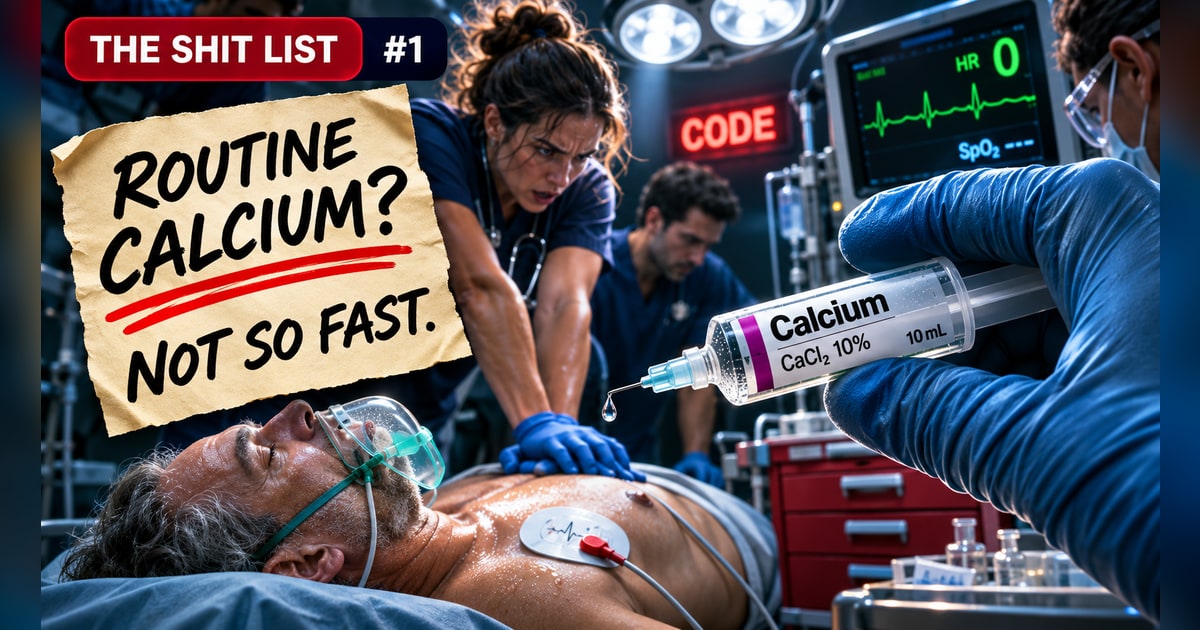
The Shit List #1: Calcium in Cardiac Arrest. A Good Drug, a Bad Reflex.
The trolley is well stocked. The evidence is rather less enthusiastic.
Sonny Saggar, MD · 2026-11-05
The verdict
The habit: Giving calcium during adult cardiac arrest because an arrest is happening, rather than because there is a specific reason to give calcium.
The evidence: The American Heart Association’s 2025 guidelines advise against routine calcium in adult cardiac arrest. The classification is Class 3: No Benefit, based on randomised evidence (B-R). [1]
The action: Stop putting calcium in the category of things to give automatically. Keep it available for properly assessed clinical indications.
This is a story about a bad reflex, not a bad drug.
The tyranny of the well-stocked trolley
I spent more than 25 years in emergency medicine. One thing I learnt is that an emergency can make an intervention look worthwhile simply because someone is able to do it.
A resuscitation trolley is a particularly persuasive object. It has drawers, labels, sterile packaging and an air of readiness. Every ampoule looks as though it has been personally invited to the occasion.
Unfortunately, the patient has not seen the guest list.
Calcium is essential to normal cardiac contraction. Nobody disputes that. But calcium is necessary for the heart to work is not the same proposition as extra calcium improves outcomes in people whose hearts have stopped. The first is physiology. The second needs a clinical trial.
Medicine becomes strangely sentimental about things that look like treatment. Under pressure, doing something can feel morally superior to doing nothing. The trouble is that an unnecessary treatment is not transformed into a useful one by the sincerity with which it is administered.
The trial that made things awkward
In 2021, the COCA trial in JAMA compared calcium against saline placebo in adults with out-of-hospital cardiac arrest. Its primary outcome was sustained return of spontaneous circulation, or ROSC: the heart recovering a pulse that lasted. [2]
Among 391 adults analysed:
The trial stopped early after an interim analysis raised concern about possible harm.
One could write the headline, Calcium kills eight extra patients per hundred. One could also write a rather angry letter when the statistician explained why that statement went beyond the evidence.
The difference did not meet the usual threshold for statistical significance. The interval allows for anything from substantial harm to a small benefit. And early-stopped trials can exaggerate an apparent effect. These qualifications are not embarrassing footnotes. They are what make the article worth trusting.
What the trial did not demonstrate was a benefit from routinely giving calcium. It also raised a serious enough question about harm to merit attention.
I do not need a drug to be convicted of murder before removing it from the routine order set.
- 37 of 193 (19%) allocated calcium achieved sustained ROSC.
- 53 of 198 (27%) allocated saline achieved sustained ROSC.
- The estimated difference was minus 7.6 percentage points. The 95% confidence interval ranged from minus 16 to plus 0.8 points, with P = 0.09.
- At 30 days, 5.2% of calcium recipients and 9.1% of saline recipients were alive. That comparison was also statistically uncertain. [2]
And this was not the only evidence
A 2023 systematic review identified three randomised trials involving 554 adults with out-of-hospital cardiac arrest and eight observational studies involving 2,731 adults. The evidence did not show improved outcomes with routine calcium. [3]
Observational studies have a special trap here. A clinician may reach for calcium towards the end of an already prolonged and unsuccessful resuscitation. Those patients may do badly because the arrest was going badly, not because the calcium caused the outcome. This is called confounding by resuscitation time, and it is a reason to value randomised evidence, not to ignore every observational result.
The 2023 international consensus recommended against routine calcium in adult out-of-hospital arrest and suggested against it in in-hospital arrest, where the evidence is less certain. [4] The AHA’s focused update in 2023 and its full 2025 guideline agreed. [1,5]
There is another awkward date. The international recommendation against routine calcium was already present in 2010. [4]
It has not exactly arrived without warning.
Yes, calcium still has important uses
Someone will quite reasonably ask about a patient with hyperkalaemia, hypocalcaemia or calcium-channel blocker poisoning. Good. That is the conversation we should have been having before opening the ampoule.
The 2025 AHA special-circumstances guidance considers calcium reasonable in life-threatening calcium-channel blocker poisoning, although much of the direct evidence is limited. [6] Calcium can also be appropriate when a genuine calcium deficiency needs treatment.
Hyperkalaemic cardiac arrest is more complicated. Calcium has a familiar role in dangerous hyperkalaemia outside cardiac arrest, but the AHA says the effectiveness of IV calcium during arrest from suspected hyperkalaemia is not well established. There are no high-quality human trials settling that subgroup. [6]
A pre-planned COCA analysis involving 104 patients with pulseless electrical activity did not show a calcium benefit, including in subgroups with ECG features potentially associated with hyperkalaemia. The estimates were imprecise, and ECG patterns are not the same as proof of hyperkalaemia. [7]
So we must not turn don’t give calcium routinely into never give calcium. That would merely replace one thoughtless rule with another. The correct question is what underlying problem we suspect, how strongly we suspect it and what guidance applies to that circumstance.
What we do about it
1. Audit the protocol, not just the cupboards. Compare code records, standing orders, ambulance pathways and training material against the 2025 AHA guideline. A laminated card is not a guarantee of current evidence. [1]
2. Ask for an indication. During arrest, if calcium is requested, the team should be able to name the suspected cause. This must not delay a justified time-critical intervention; it should prevent unexamined routine use.
3. Teach the exceptions honestly. Hyperkalaemia in arrest, important calcium abnormalities and toxicological emergencies need carefully differentiated pathways, not slogans. [6]
4. Measure what actually happens. Review the proportion of arrest cases receiving calcium and whether an indication was documented. Also check for unintended delays to appropriate treatment after changing a protocol.
5. Be willing to update the conclusion. If better trials establish benefit in a defined subgroup, follow the evidence. I am not defending an article. I am defending the principle that patients deserve a reason for what we do.
The strongest objection
Perhaps there is a subgroup in which calcium does help. Quite possibly. The international consensus explicitly identifies gaps in evidence for special circumstances. [4,8]
But a possible subgroup benefit is a research question, not a standing order for everybody else. The absence of proof of benefit is not proof of harm. It is, however, a good reason to stop giving a treatment indiscriminately.
Do what works. Retire what is merely familiar. Keep the exceptions where they belong.
Not a particularly glamorous reform. No new machine. No expensive conference. Not even a souvenir ampoule.
Just a better decision.
About The Shit List
The Shit List is an ongoing series by Sonny Saggar, MD, drawing on more than 25 years in emergency medicine. It examines the drugs, doses, tests, procedures and institutional habits that may have outlived the evidence for their routine use. Future instalments will tackle unnecessary investigations, extravagant dosing, resuscitation rituals, billing incentives and the curious assumption that expensive must mean better. Every piece presents the counterargument, acknowledges the exceptions and ends with something practical. Lamentation without action is useless. It is also rather tedious.
Sources and receipts
- AHA. 2025 Adult Advanced Life Support, section 11 (nonvasopressor medications). — Original cited source [1]
- Vallentin MF et al. COCA randomised clinical trial. JAMA. 2021. DOI: 10.1001/jama.2021.20929. — Original cited source [2]
- Hsu CH et al. Calcium during cardiac arrest: systematic review. Resuscitation Plus. 2023;14:100379. DOI: 10.1016/j.resplu.2023.100379. — Original cited source [3]
- ILCOR. 2023 International Consensus on CPR and ECC, calcium recommendations and knowledge gaps. — Original cited source [4]
- AHA. 2023 Focused Update on Adult Advanced Cardiovascular Life Support. DOI: 10.1161/CIR.0000000000001194. — Original cited source [5]
- AHA. 2025 Special Circumstances of Resuscitation, hyperkalaemia and calcium-channel blocker poisoning sections. — Original cited source [6]
- COCA pre-planned PEA and ECG sub-study. Resuscitation. 2022. — Original cited source [7]
- ILCOR. 2025 Advanced Life Support Consensus. DOI: 10.1161/CIR.0000000000001360. — Original cited source [8]
From the same professional problem-solving perspective: YouTube · Spotify · Substack.