An illustrated question from Why Aren’t We Spheres?
Why are planets round, but people are not?
By Sonny Saggar
If a sphere is such a good shape, why are you not one? Before blaming nature’s workmanship, ask what the object is made of, how large it is and what it must do.
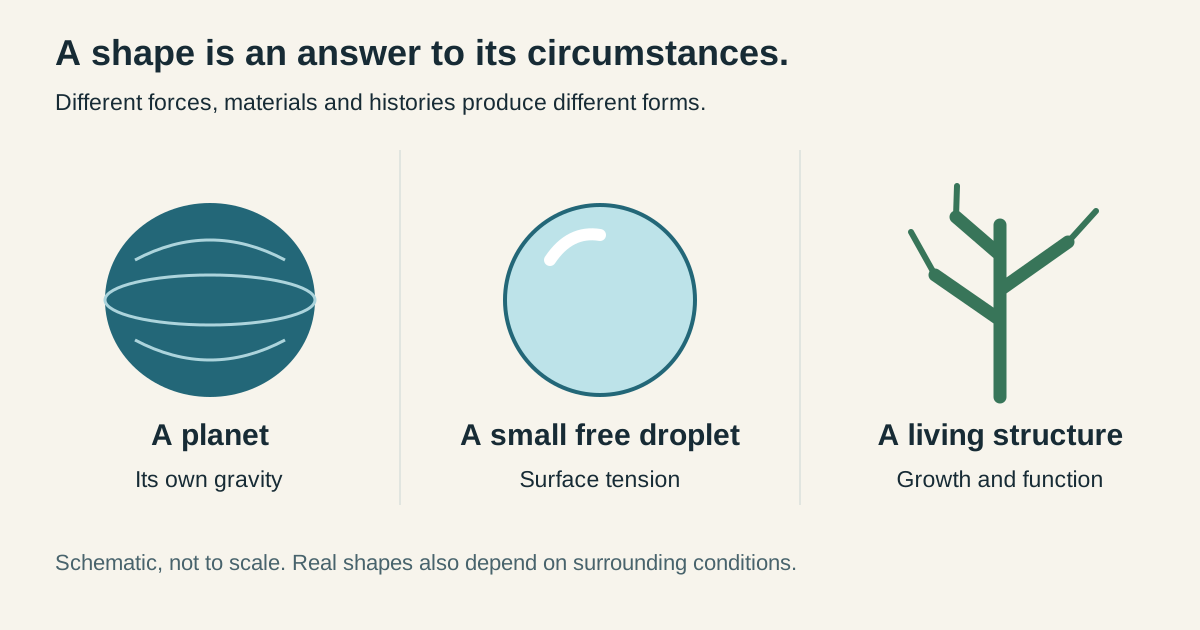
A planet: its own gravity matters
Mass attracts mass. In a sufficiently large body, self-gravity can overcome the material’s resistance to being reshaped, producing a nearly round overall form. Rotation can flatten that form at the poles. “Round” does not mean a perfectly smooth mathematical sphere.
NASA’s explanation of planetary roundness introduces the role of gravity. Small rocky objects can retain much more irregular shapes.
A droplet: a different route to roundness
For a small, free droplet where gravity and other distortions are negligible, surface tension tends to reduce surface area. For a fixed volume, a sphere has the least surface area. A drop on a leaf also interacts with the leaf; a falling drop also interacts with the air. Change the situation and its shape can change.
A living body: structure, growth and history
A person is not a free liquid drop. Bones and tissues resist deformation. Cells grow and organize in particular ways. Bodies also have to move, exchange substances and interact with their surroundings. Evolution works with inherited structures rather than starting from a blank drawing board.
Fingers illustrate the point. They can grip a handle, feel a surface and manipulate small objects. “Smallest outside area” is not the only relevant consideration for a hand.
Ask three questions about any shape
- What forces matter here? Gravity, surface tension and other forces do not matter equally at every scale.
- What does the material allow? Water flows differently from a crystal or a tree trunk.
- How did it grow or form? A shape can preserve the history of how it came into being.
Try it without special equipment
Compare a small drop on a spoon, a grain of salt and a leaf. Describe each outline before offering an explanation. What evidence would distinguish your explanation from another one? A tempting pattern is a starting point for a question, not proof of an answer.
Follow the question
Why Aren’t We Spheres? follows natural shapes through drops, planets, crystals and living things, with illustrations and accessible explanations. This companion is a new introductory explanation, not a reproduced page from the book.